Frozen Shoulder (Adhesive Capsulitis): Natural Homeopathic Cure for Stiff Shoulder Joint Mobilization
Clinical Executive Summary:
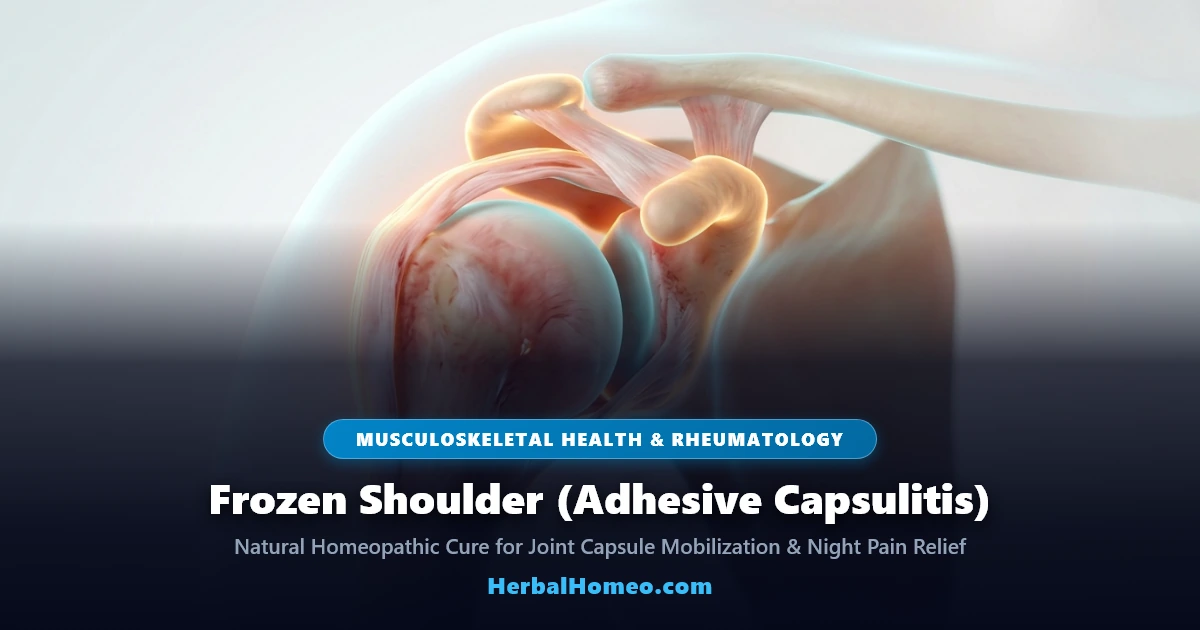
• Pathological Nature: Adhesive capsulitis (frozen shoulder) is a debilitating fibroproliferative condition characterized by severe synovial inflammation, capsular fibrosis, and profound contracture of the glenohumeral joint capsule.
• The Clinical Agony: Patients suffer from a progressive loss of active and passive range of motion (ROM) in all planes, severe nocturnal exacerbation, and the inability to carry out simple activities of daily living (such as reaching backward, fastening clothes, or combing hair).
• Conventional Limitations: Reliance on oral NSAIDs, repeated intra-articular corticosteroid injections, or aggressive manipulation under anesthesia (MUA) often provides only short-term analgesia while accelerating connective tissue atrophy and risking rotator cuff tears.
• The Homeopathic Paradigm: Targeted constitutional and organopathic homeopathic remedies (such as Ferrum🌿 FerrumMateria Medica Clinical Profile: Click to explore Boericke keynotes, symptoms, modalities, and dosage guidelines. Metallicum, Sanguinaria🌿 SanguinariaMateria Medica Clinical Profile: Click to explore Boericke keynotes, symptoms, modalities, and dosage guidelines. Canadensis, Rhus🌿 RhusMateria Medica Clinical Profile: Click to explore Boericke keynotes, symptoms, modalities, and dosage guidelines. Toxicodendron, and Bryonia🌿 BryoniaMateria Medica Clinical Profile: Click to explore Boericke keynotes, symptoms, modalities, and dosage guidelines. Alba) address the deep underlying microvascular inflammation, resolve capsular adhesions, and re-establish synovial lubrication naturally without surgical intervention.
Understanding the Pathophysiology of Frozen Shoulder (Adhesive Capsulitis)
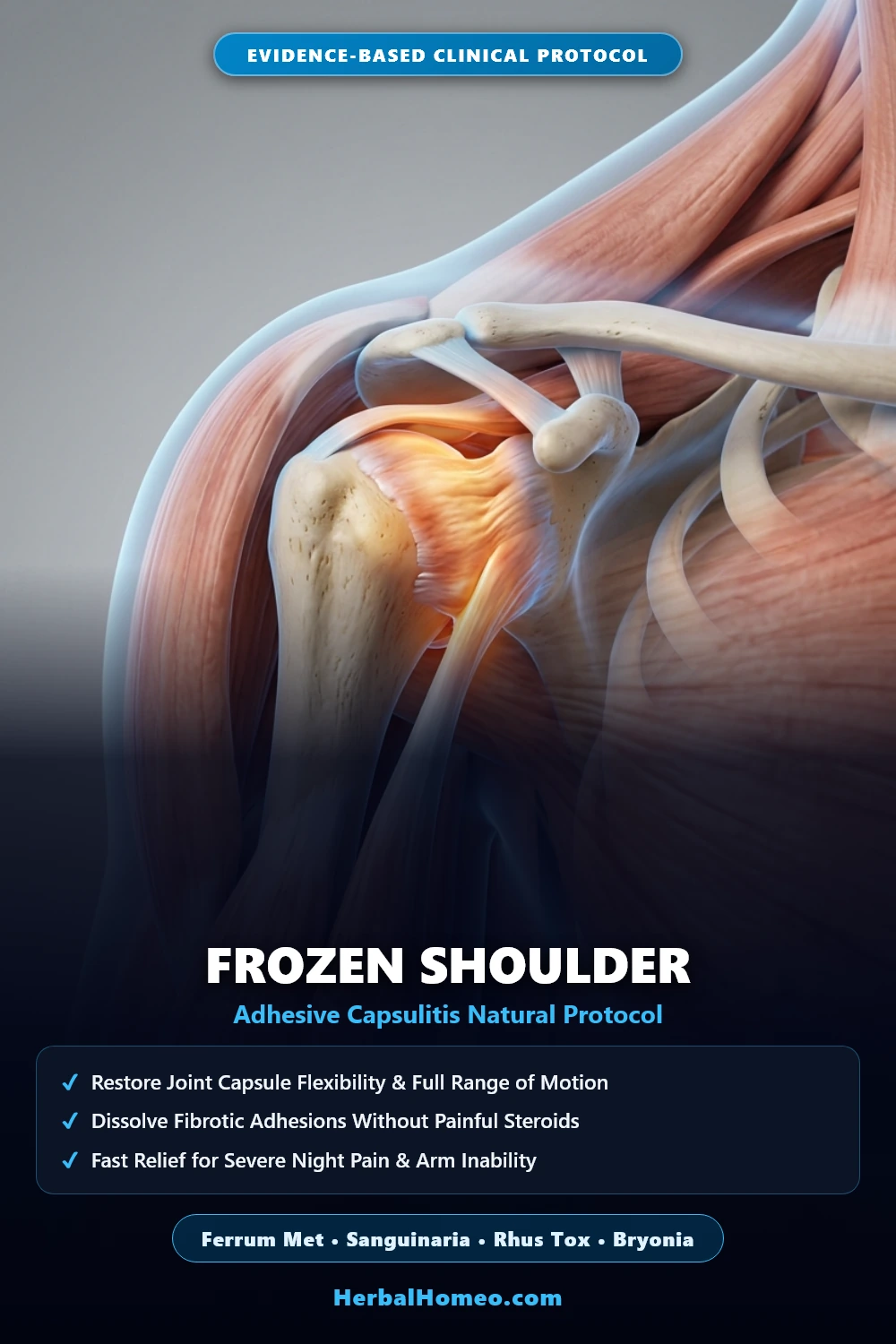
The human glenohumeral joint is an exceptionally mobile ball-and-socket mechanism enclosed by a fibrous sleeve known as the joint capsule. Under physiological conditions, this capsule is remarkably compliant, containing ample redundant folds (the axillary pouch) and bathed in lubricating synovial fluid to facilitate uninhibited humeral elevation and rotation.
In adhesive capsulitis, an abnormal immune and inflammatory cascade triggers myofibroblast activation and excessive type I and type III collagen deposition within the joint capsule. The capsular ligaments thicken, become shortened and fibrotic, and adhere firmly to the humeral head. Concurrently, intra-articular synovial fluid volume collapses from a normal 15–30 mL down to less than 3–5 mL, effectively cementing the shoulder joint in place.
The Three Classic Clinical Phases
Frozen shoulder characteristically progresses through three distinct, overlapping developmental stages:
- 1. The Freezing (Inflammatory) Stage: Lasting from 2 to 9 months, this stage presents with insidious, progressive, diffuse shoulder pain that worsens dramatically at night and when lying on the affected side. As inflammatory synovitis peaks, joint motion begins to tighten.
- 2. The Frozen (Fibrotic Contracture) Stage: Lasting from 4 to 12 months, acute pain may somewhat level off into a dull ache, but joint stiffness becomes profound. External rotation, abduction, and internal rotation are severely restricted. The arm feels physically mechanically blocked.
- 3. The Thawing (Recovery) Stage: Lasting from 6 to 24 months or longer, the fibrotic adhesions slowly remodel. However, without proactive, restorative treatment, many patients never regain full functional mobility and are left with chronic compensatory scapular dyskinesis.
Primary Etiologies and High-Risk Patient Profiles
While primary adhesive capsulitis is considered idiopathic, several metabolic and mechanical predisposing factors significantly elevate risk:
- Diabetes Mellitus: Diabetic individuals demonstrate up to a 20% lifetime incidence of adhesive capsulitis (frequently bilateral) driven by non-enzymatic glycosylation of collagen and microvascular impairment.
- Endocrine Dysfunctions: Both hypothyroidism🩺 HypothyroidismClinical Disease Treatment Profile: Read homeopathic remedies, dietary recommendations, and natural therapeutic options. and hyperthyroidism🩺 HyperthyroidismClinical Disease Treatment Profile: Read homeopathic remedies, dietary recommendations, and natural therapeutic options. are strongly correlated with inflammatory capsulitis.
- Gender and Age: Highest prevalence occurs in individuals aged 40 to 65, with a higher predilection in females during the perimenopausal transition.
- Secondary Prolonged Immobilization: Post-operative recovery, stroke🩺 StrokeClinical Disease Treatment Profile: Read homeopathic remedies, dietary recommendations, and natural therapeutic options., mastectomy, or cardiovascular procedures that keep the arm immobilized often trigger rapid capsular contraction.
Critical Limitations of Corticosteroid Injections and Surgical MUA
Modern conventional management frequently relies on local hydrocortisone injections. While corticosteroids temporarily silence inflammatory cytokines, multiple clinical trials demonstrate that they provide negligible benefit beyond 6–12 weeks. Furthermore, repeated steroid infiltrations accelerate rotator cuff tendon degradation, chondrotoxicity, and systemic glycemic spikes in diabetic patients.
Similarly, Manipulation Under Anesthesia (MUA) forcibly tears the fibrotic capsule while the patient is unconscious. This blunt force carries significant risks of glenoid labrum tears, humeral fractures, and recurrent secondary scarring from acute mechanical trauma.
Evidence-Based Homeopathic Therapeutics for Frozen Shoulder
Homeopathy restores joint range of motion by resolving the underlying microvascular inflammation, modulating fibrogenesis, and revitalizing synovial secretion. Clinical selection requires rigorous matching of lateral affinity (right vs. left) and functional modalitiesFactors that make symptoms better or worseEnvironmental influences (like temperature, weather, rest, motion, or time of day) that modify symptoms.:
1. Ferrum Metallicum (30C / 200C) — Deltoid Agony & Severe Left-Sided Rigidity
A pre-eminent remedy for severe shoulder joint stiffness, showing an elective affinity for the left shoulder and the deltoid tendon insertion. The patient is completely incapable of abducting or raising the arm. Pain is excruciatingly aggravated in bed at night, forcing the patient to arise and walk slowly about to obtain slight relief. Movement initially is acutely painful.
2. Sanguinaria Canadensis (30C / 200C) — Specific for Right-Sided Adhesive Capsulitis
Sanguinaria is the classic specific remedy for the right shoulder joint. The patient experiences intense, tearing, burning pain radiating into the right deltoid muscle, rendering lateral arm elevation impossible. Pain peaks at night when lying on the affected right side and during rotational maneuvers (such as reaching into a back pocket). Often accompanied by occipital-frontal headaches or vasomotor flushing.
3. Rhus Toxicodendron (30C / 200C) — Morning Stiffness & Capsular Fibrosis
Indicated when capsulitis is accompanied by profound ligamentous and tendon stiffness. Characteristic modalities are hallmark: the shoulder is painfully rigid and immobile upon waking or after resting. Initial motion causes sharp pain, but with gentle, continuous movement, the joint warms up and mobility dramatically improves. Symptoms flare up acutely in cold, damp, rainy weather and are markedly soothed by hot showers and warm compresses.
4. Bryonia Alba (30C / 200C) — Stitching Pains Aggravated by the Slightest Motion
In direct opposition to Rhus Tox, the Bryonia patient is intensely aggravated by any movement whatsoever. The slightest rotational twitch or attempt to lift the arm causes sharp, stitching, knife-like pains. The joint feels dry, hot, and stiff. Complete immobility, supporting the arm firmly against the torso, and lying directly on the affected side (firm pressure) provide the only relief.
5. Ruta🌿 RutaMateria Medica Clinical Profile: Click to explore Boericke keynotes, symptoms, modalities, and dosage guidelines. Graveolens (30C) — Tendon Remodeling & Post-Traumatic Capsular Strain
Exerts deep trophic action on the periosteum, fibrous ligaments, and rotator cuff tendons. Indicated when frozen shoulder emerges secondary to chronic repetitive overhead strain or an unhealed fall. Patients complain of a deep, bruised, bruised-bone ache with intense tendon tightness.
Clinical Remedy Comparison Matrix
| Homeopathic Medicine | Lateral Affinity & Target | Aggravating Modalities | Ameliorating Modalities | Recommended PotencyStrength level of a remedyThe dilution and succussion scale of a remedy (e.g., 6C, 30C, 200C, 1M), indicating its energetic concentration. |
|---|---|---|---|---|
| Ferrum Metallicum | Left shoulder, deltoid tendon, arm immobility | Motion, lying still in bed at night | Gentle walking, keeping warm | 30C or 200C |
| Sanguinaria Can.🌿 Can.Materia Medica Clinical Profile: Click to explore Boericke keynotes, symptoms, modalities, and dosage guidelines. | Right shoulder, acute deltoid pain | Night in bed, turning on right side | Keeping arm immobilized at side | 30C or 200C |
| Rhus Toxicodendron | Severe capsular contracture & stiffness | Initial motion, cold damp weather, rest | Continuous gentle motion, heat | 30C or 200C |
| Bryonia Alba | Sharp stitching pain, synovial dryness | Any movement, jarring, deep breath | Absolute rest, firm external pressure | 30C or 200C |
| Ruta Graveolens | Periosteal wear, tendon strain & bruising | Cold air, exertion, hanging arm down | Warmth, mild flexion | 30C |
Restorative Physical Mobilization Exercises (Non-Aggressive)
While homeopathic remedies dismantle inflammatory adhesions internally, gentle physiological mobilization encourages synovial circulation:
- Codman’s Pendulum Exercise: Lean forward, supporting the torso with the unaffected arm on a table. Allow the affected arm to dangle freely toward the floor. Use torso momentum to gently sway the relaxed arm in clockwise, counter-clockwise, and forward-backward circles without active shoulder muscle contraction.
- Finger Ladder Wall Walk: Face a wall at an arm’s distance. Use the fingertips of the affected arm to “walk” up the wall like a spider until mild resistance is reached. Hold for 10 seconds, then slowly walk fingers down. Perform 5 repetitions twice daily.
- Towel Internal Rotation Stretch: Hold a towel behind your back with the healthy hand overhead and the affected hand behind the lower back. Gently lift upward with the top hand to assist mild internal rotation stretch within pain-free limits.
Medical Disclaimer: This guide is for educational reference. Severe acute shoulder pain radiating into the chest, jaw, or left arm accompanied by shortness of breath requires immediate emergency cardiology evaluation. Consult a licensed homeopathic physician for personalized posology.
How does homeopathy approach treating frozen shoulder compared to conventional methods?
What kind of results can I expect, and how long does it typically take to see improvement with homeopathic remedies for frozen shoulder?
Are homeopathic remedies safe to use alongside physiotherapy or other conventional treatments for frozen shoulder?
What kind of results can I expect, and how long does it typically take to see improvement with homeopathic remedies for frozen shoulder?
Are homeopathic remedies safe to use alongside physiotherapy or other conventional treatments for frozen shoulder?
Classic Clinical PhasesPrimary Etiologies and High-Risk Patient ProfilesCritical Limitations of Corticosteroid Injections and Surgical MUAEvidence-Based Homeopathic Therapeutics for Frozen Shoulder1.
What kind of results can I expect, and how long does it typically take to see improvement with homeopathic remedies for frozen shoulder?
This article is for educational purposes only and not a substitute for professional medical advice, diagnosis, or treatment. Always seek the advice of your physician or other qualified health provider with any questions you may have regarding a medical condition.

Dr. Luqman Naseer
This article is for informational purposes and has been reviewed for medical accuracy according to classical homeopathic principles. Editorial Policy.