
Migraine: Homeopathic Care & Natural Relief: Clinical Guide
MigraineSevere recurring headache, often on one sideA recurrent throbbing headache that typically affects one side of the head and is often accompanied by nausea and disturbed vision. and chronic cephalalgia present some of the most debilitating neurological challenges encountered in modern clinical practice. Characterized by paroxysmal episodes of intense, often unilateral pain accompanied by sensory amplification, autonomic disturbance, and gastric distress, migraines transcend simple tension. The conventional pathophysiological model highlights neurogenic inflammation, cortical spreading depression, and trigeminovascular sensitization as core drivers. ComplementaryAssisting or completing remedyA remedy that naturally follows and completes the action of another remedy, helping it work better. to conventional evaluations, individualized homeopathic care focuses on addressing systemic susceptibility, tracking patient-specific modalitiesFactors that make symptoms better or worseEnvironmental influences (like temperature, weather, rest, motion, or time of day) that modify symptoms., and moderating the nervous system’s reactivity.
Understanding the Neurobiology of Migraine and Head Pain
To support individuals dealing with recurrent cephalalgia, clinicians must evaluate the complex neurovascular cascade. Migraine is fundamentally a primary headache disorder rooted in central nervous system hyperexcitability. When a migraine cascade initiates, sensory nerves surrounding cranial blood vessels—notably branches of the trigeminal nerve—release calcitonin gene-related peptide (CGRP), substance P, and other inflammatory neuropeptides.
This neurochemical release leads to sterile neurogenic inflammation, vasodilatation, and secondary sensitization of both peripheral and central pain pathways. Patients consequently experience allodynia, where normally non-noxious stimuli—such as ambient indoor lighting, ordinary room sounds, gentle hair combing, or minor postural shifts—become triggers of sharp distress. Tension-type headaches and cervicogenic headaches, while structurally distinct from classic vascular migraines, frequently co-exist, establishing a complex clinical picture of chronic craniofacial discomfort.
The Individualized Homeopathic Methodology
Homeopathic medicine does not approach recurrent head pain as an isolated symptom requiring blanket suppression. Rather, the clinician evaluates the entire symptom complex—examining not merely the location of pain, but its sensation, direction of extension, functional triggers, and modifying modalities. How the patient responds to thermal changes, atmospheric pressure, emotional conflict, and sensory stimuli provides essential diagnostic indicators for selecting an appropriate single remedy.
In classical homeopathy, acute symptom episodes are treated with medicines matched to the immediate presentation, while long-term care involves constitutional prescribing aimed at stabilizing the patient’s intrinsic neurovascular equilibrium. By addressing constitutional vitality alongside physiological triggers, clinical practitioners seek to decrease both the frequency and the severity of chronic episodes over time.
Five Core Homeopathic Remedies in Headache Management
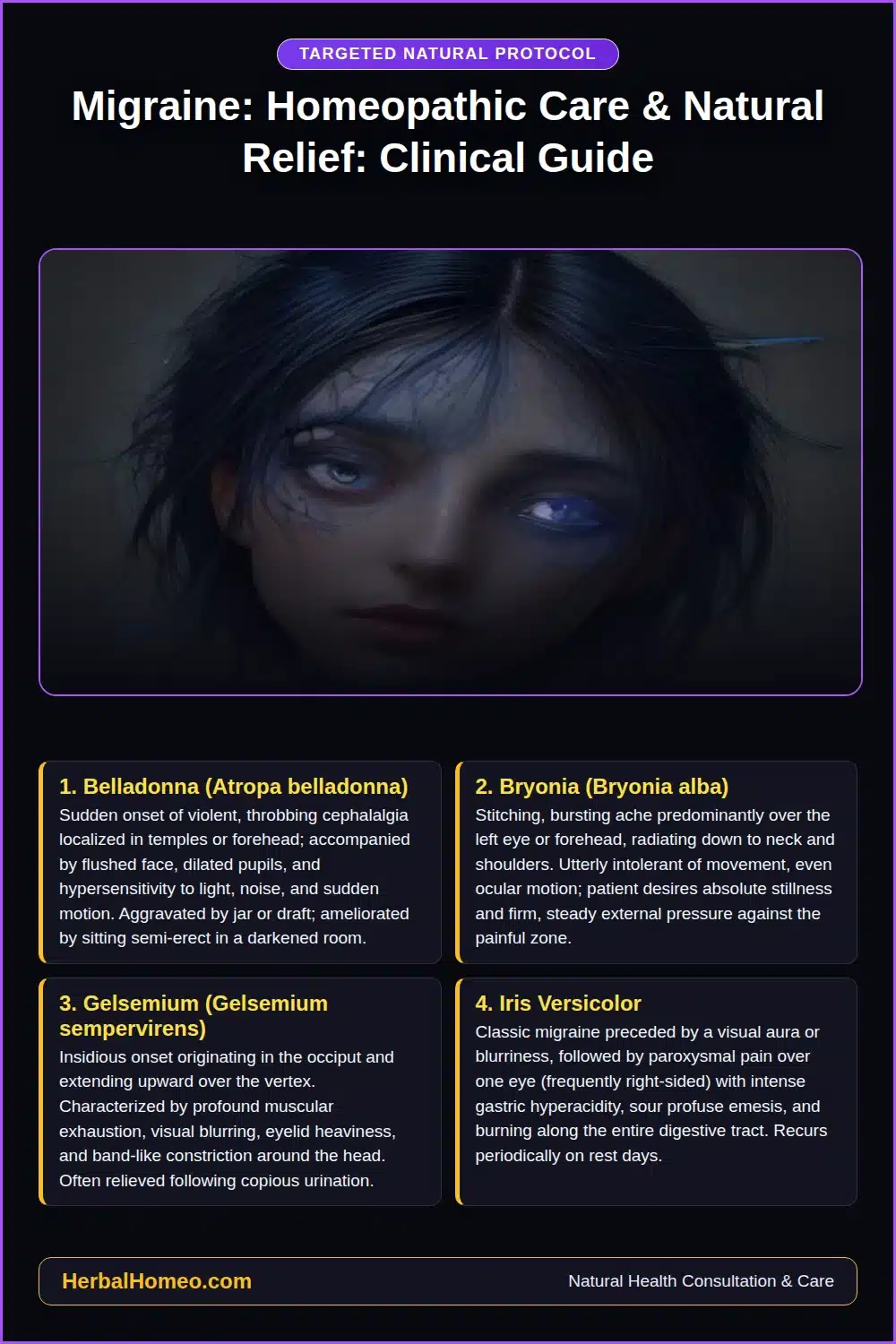
1. Belladonna (Atropa belladonna)
Belladonna is classically indicated in hyperacute, hyperemic vascular events. The onset of the headache is extraordinarily rapid, reaching peak intensity within minutes. The pain is typically throbbing, pounding, or pulsating, centered primarily in the temples, forehead, or right side of the cranium.
Clinical signs include a hot, flushed, or crimson face, cold extremities, prominent carotid pulsations, and noticeably dilated pupils. Patients exhibit profound photophobiaExtreme sensitivity to lightAn abnormal intolerance to light, causing eye discomfort, squinting, or pain in bright environments. and phonophobia. A hallmark of Belladonna is extreme sensitivity to jarring movements; even the slight vibration of footsteps on the floor or the sudden movement of a bed can intensify the pain. Relief is commonly sought by sitting upright in a silent, dark room and applying cold compresses to the forehead.
2. Bryonia🌿 BryoniaMateria Medica Clinical Profile: Click to explore Boericke keynotes, symptoms, modalities, and dosage guidelines. Alba
Bryonia is primarily indicated when motion is the dominant aggravating factor. The headache is characterized by a bursting, heavy, or splitting sensation, commonly localizing over the left frontal sinus or settling firmly behind the eyes before spreading backward into the occiput.
Unlike conditions that permit restless pacing, the Bryonia individual demands complete stillness. Even minor ocular adjustments—moving the eyes from side to side—can trigger sharp, stitching paroxysms of pain. The patient is often irritable, thirsty for substantial quantities of cold water🌿 WaterMateria Medica Clinical Profile: Click to explore Boericke keynotes, symptoms, modalities, and dosage guidelines., and experiences dry mucosal membranes. AggravationWorsening of symptomsAn increase in severity or intensity of symptoms, often caused by environmental factors or after taking a remedy. occurs from stooping, warmth, and postprandial digestion. Clinically, patients often gain moderate comfort by lying on the painful side, which provides steady, firm mechanical counter-pressure.
3. Gelsemium🌿 GelsemiumMateria Medica Clinical Profile: Click to explore Boericke keynotes, symptoms, modalities, and dosage guidelines. Sempervirens
Gelsemium suits headaches originating from nervous exhaustion, emotional anticipation, or viral convalescence. The onset is insidious, building gradually over hours or days. The pain originates at the base of the skull in the suboccipital region and ascends over the vertex to settle into the forehead and orbits.
Patients present with an overarching sense of physical dullness, profound lethargy, and muscular weakness. The eyelids droop heavily, and the vision may become hazy, blurred, or double prior to or during the attack. The head feels congested and wrapped in a tight, constrictive band. Distinctively, patients frequently report marked relief following the spontaneous passage of copious, clear urine, alongside gentle elevation of the head on pillows.
4. Iris🌿 IrisMateria Medica Clinical Profile: Click to explore Boericke keynotes, symptoms, modalities, and dosage guidelines. Versicolor
Iris versicolor corresponds closely to migraine syndromes characterized by marked gastrointestinal and visual disturbances. The episode frequently begins with a sensory aura, such as sparkling lights, hemianopia, or visual blurring. As the visual symptoms clear, a severe, throbbing hemicrania develops, most commonly on the right side.
The cardinal keynote of Iris versicolor is severe involvement of the alimentary tract. The patient experiences intense gastric hyperacidity, producing nausea and frequent, profuse vomiting of bitter🌿 BitterMateria Medica Clinical Profile: Click to explore Boericke keynotes, symptoms, modalities, and dosage guidelines., sour, or bilious matter that scalds the throat. These episodes often present a cyclical, periodic schedule, frequently manifesting on weekends, days off, or immediately following periods of intense intellectual exertion.
5. Sanguinaria🌿 SanguinariaMateria Medica Clinical Profile: Click to explore Boericke keynotes, symptoms, modalities, and dosage guidelines. Canadensis
Sanguinaria Canadensis is a predominant right-sided remedy. The cephalalgia typically starts in the morning upon waking, rooted in the occipital or posterior cervical musculature. As the sun ascends, the pain climbs across the vertex and concentrates intensely over the right temporal bone and behind the right eye.
The pain exhibits a regular diurnal rhythm, increasing in severity until midday and then gradually waning toward nightfall. Patients often display marked redness or circumscribed flush over the cheekbones, along with nausea and sensitivity to odors and sound. Relief is classically noted when lying quietly on the right side in a darkened room, following sleep, or after gentle bilious discharge.
Integrative Lifestyle Strategies for Neurological Stability
Sustained management of chronic headaches requires removing environmental and metabolic triggers that lower the neurological threshold for an attack. Homeopathic care functions optimally when paired with fundamental physiological support.
Cellular Hydration and Electrolyte Balance: Dehydration directly influences blood volume and intracranial pressure dynamics. Drinking consistent amounts of pure water throughout the day, supported by natural mineral intake (Magnesium🌿 MagnesiumMateria Medica Clinical Profile: Click to explore Boericke keynotes, symptoms, modalities, and dosage guidelines., sodium, Potassium🌿 PotassiumMateria Medica Clinical Profile: Click to explore Boericke keynotes, symptoms, modalities, and dosage guidelines.), prevents the compensatory cranial vasoconstriction that often triggers vascular pain.
Metabolic and Dietary Regulation: Maintaining stable blood glucose levels is paramount. Reactive hypoglycemia🩺 HypoglycemiaClinical Disease Treatment Profile: Read homeopathic remedies, dietary recommendations, and natural therapeutic options. triggers compensatory catecholamine surges, stimulating the trigeminovascular system. Emphasizing anti-inflammatory whole foods while identifying individual dietary sensitivities—such as aged cheeses containing tyramines, nitrates, excessive histamines, and artificial additives—lessens background neuroinflammation.
Circadian and Sleep Hygiene: Inconsistent sleep schedules, insufficient slow-wave sleep, and sudden shifts in sleep patterns can provoke migraines. Establishing regular wake and sleep intervals reinforces the hypothalamic rhythms that stabilize autonomic nervous system tone.
Stress Regulation and Autonomic Balance: Chronic sympathetic hyper-reactivity elevates base muscle tone in the trapezius, splenius capitis, and temporomandibular structures. Integrating nervous system down-regulation methods—such as slow diaphragmatic breathing, biofeedback, and somatic relaxation—helps preserve nervous resilience.
Clinical Red Flags and Safety Parameters
While primary headaches respond well to integrative support, clinicians and patients must maintain vigilance regarding secondary headaches resulting from serious underlying pathology. Immediate emergency medical evaluation is necessary if a patient experiences:
- A sudden, severe headache that reaches peak intensity within seconds (a “thunderclap” presentation).
- New or focal neurological deficits, including facial droop, motor hemiparesis, severe aphasia, or progressive visual field loss.
- Headache accompanied by systemic symptoms such as high fever, neck stiffness (nuchal rigidity), confusion, or cognitive alteration.
- New headache patterns presenting for the first time in individuals over the age of fifty or those with a history of malignancy.
Careful differential diagnosis guarantees that natural and homeopathic therapeutics are deployed within an ethically sound, safe framework.
A Collaborative Path to Long-Term Relief
Managing migraines and chronic headaches requires patience, methodical observation, and customized clinical reasoning. By evaluating the individualized nature of your symptoms and supporting your body’s intrinsic physiological balance, homeopathy offers a focused, gentle modality to enhance overall neurological well-being.
This article is for education and does not replace diagnosis or treatment by your doctor. Do not stop prescribed medication without medical advice.
If you are navigating recurrent headaches and seeking an individualized, clinical approach, schedule a comprehensive assessment with our experienced team. Book your professional consultation today to explore natural, personalized strategies tailored to your long-term health.
This article is for educational purposes only and not a substitute for professional medical advice, diagnosis, or treatment. Always seek the advice of your physician or other qualified health provider with any questions you may have regarding a medical condition.

Dr. Luqman Naseer
This article is for informational purposes and has been reviewed for medical accuracy according to classical homeopathic principles. Editorial Policy.