Eczema: Homeopathic Care & Natural Relief: Clinical Guide
Atopic dermatitisInflammation of the skinA general term for skin irritation or inflammation, causing redness, itching, and swelling. and eczemaItchy, inflamed skin conditionAn inflammatory skin rash causing dry, red, itchy, and sometimes cracking or blistered skin patches. represent some of the most prevalent, clinically challenging chronic inflammatory dermatoses encountered in modern practice. Characterized by severe pruritusSevere itching of the skinAn uncomfortable, irritating sensation of the skin that creates an urge to scratch., recurrent erythemaRedness of the skin from inflammationAn abnormal redness of the skin caused by congestion and dilation of the capillaries, often from inflammation., disrupted skin barrier integrity, and profound immunological dysregulation, this condition significantly diminishes quality of life. Conventional interventions predominantly rely on topical corticosteroids, calcineurin inhibitors, and systemic immunosuppressive agents. While these protocols deliver vital acute stabilization, many individuals seek complementaryAssisting or completing remedyA remedy that naturally follows and completes the action of another remedy, helping it work better. paradigms that address constitutional susceptibility and systemic vitality. Homeopathy provides an individualized, non-suppressive framework designed to support the body’s natural regulatory mechanisms while working alongside evidence-based dermatological care.
The Pathophysiological Landscape of Atopic Dermatitis
To appreciate how clinical homeopathy approaches atopic conditions, one must first examine the cutaneous biology involved. The skin is not merely an external covering; it is a metabolically active, neuro-immuno-endocrine organ. Atopic dermatitis is driven by two interdependent pathological features: epidermal barrier dysfunction and T-helper 2 (Th2) polarized immune hyper-reactivity.
In many individuals, mutations or downregulations in the filaggrin (FLG) gene diminish natural moisturizing factors within the stratum corneum. This genetic variance creates micro-fissuring, accelerating trans-epidermal water🌿 WaterMateria Medica Clinical Profile: Click to explore Boericke keynotes, symptoms, modalities, and dosage guidelines. loss (TEWL) and allowing environmental aeroallergens, chemical irritants, and microbial pathogens—most notably Staphylococcus aureus—to breach the cutaneous defenses. Upon penetration, these antigens trigger keratinocytes to release inflammatory cytokines such as thymic stromal lymphopoietin (TSLP), activating dendritic cells and driving Th2 cascades rich in interleukin-4 (IL-4) and interleukin-13 (IL-13). This immune cascade drives sensory nerve sensitization, instigating the hallmark symptom of eczema: the persistent, unremitting itch-scratch cycle.
The Homeopathic Perspective: Individualization and the Avoidance of Suppression
In classical and clinical homeopathy, skin eruptions are viewed as external manifestations of an internal, systemic disharmony rather than isolated surface pathology. Historical medical philosophies frequently warned against aggressive topical suppression—the rapid driving inward of cutaneous discharges or inflammation without addressing the underlying systemic dyscrasia. Clinical observations have noted that excessive suppression of eczema in atopic children may coincide with the emergence of allergic rhinitis🩺 Allergic RhinitisClinical Disease Treatment Profile: Read homeopathic remedies, dietary recommendations, and natural therapeutic options. or bronchial asthma🩺 AsthmaClinical Disease Treatment Profile: Read homeopathic remedies, dietary recommendations, and natural therapeutic options., an evolutionary process clinically recognized in modern medicine as the “atopic march.”
Rather than categorizing every patient under a generic diagnosis, homeopathic prescribing evaluates the totality of symptoms. The precise quality of the discharge, the sensory nature of the pruritus, thermal affinities, time modalitiesFactors that make symptoms better or worseEnvironmental influences (like temperature, weather, rest, motion, or time of day) that modify symptoms., environmental influences, and constitutional temperaments serve as vital clinical signposts. By matching this unique symptom complex to a well-studied simillimum, homeopathy aims to stimulate the self-regulatory adaptive capacity of the organism, encouraging cutaneous equilibrium from within.
Five Key Homeopathic Remedies in Dermatological Practice
Selecting an effective remedy demands strict adherence to the law of similars. Below are five leading medicines routinely referenced in clinical dermatological repertoire, detailed through their distinct presentations and modalities.
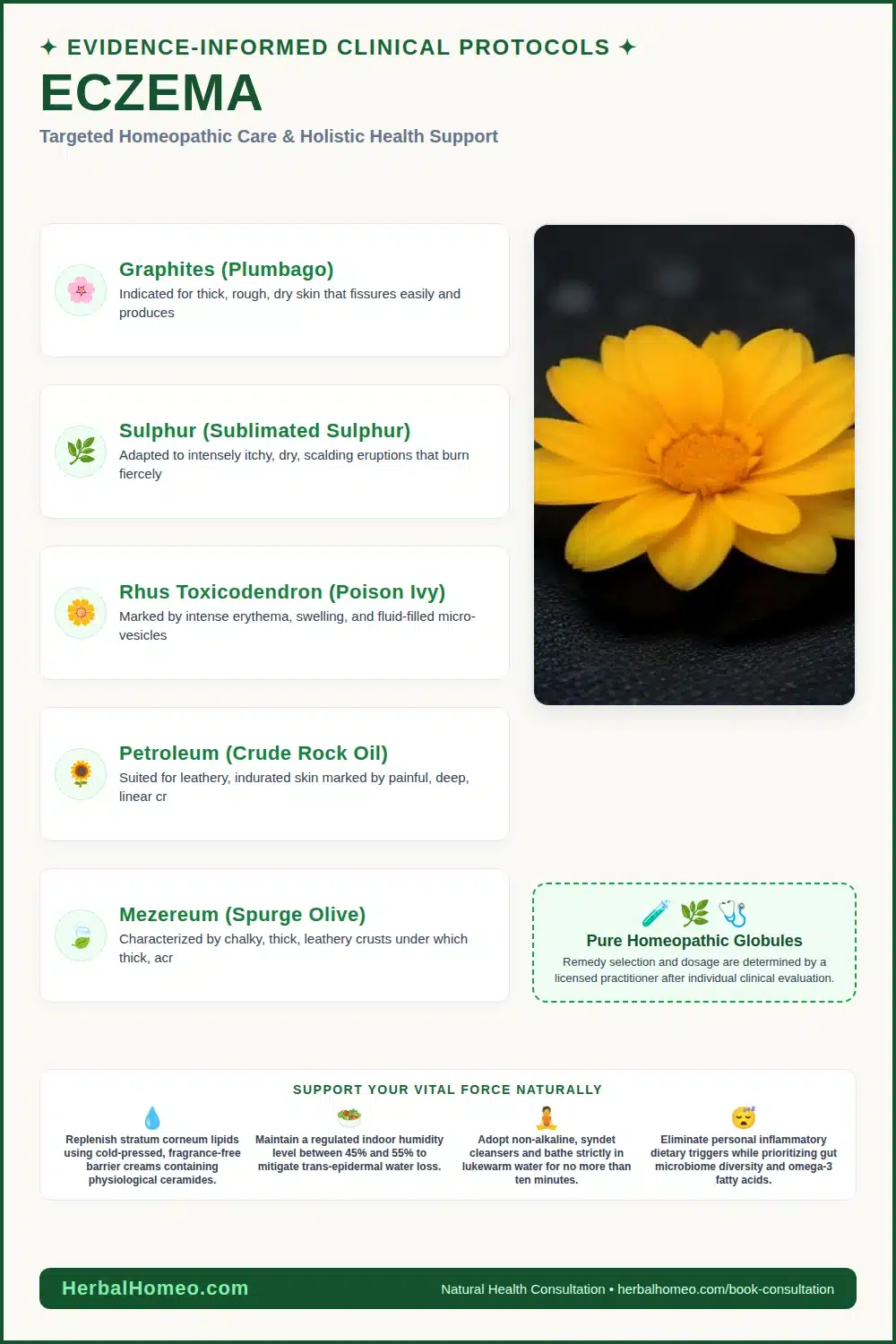
1. Graphites (Plumbago)
Graphites holds a premier position in chronic, exudative dermatoses. The primary hallmark of this remedy is a thick, glutinous, honey-colored fluid that oozes from raw, cracked surfaces. It is predominantly indicated when eczema locates within cutaneous folds: retroauricular sulci, bends of the elbows, popliteal fossae, groin, and around the eyelids or mouth.
Clinical Modalities: Symptoms intensify from local warmth, hot washing, and during the night. Patients often exhibit marked sensitivity to drafts, sluggish metabolism, lymphatic enlargement, and a propensity toward dry, hardened skin before exudationDischarge of fluid or pus from tissueThe process of fluid, cells, or other cellular substances slowly discharging from blood vessels or inflamed tissues. manifests. Relief is associated with dry air and open, cool environments.
2. Sulphur (Sublimated Sulphur)
Sulphur represents one of the deepest-acting constitutional polychrests in dermatological materia medicaEncyclopedia of homeopathic remediesA comprehensive body of collected knowledge describing the origin, preparation, and detailed symptom profiles of healing substances.. Its clinical picture is characterized by intense erythema, unremitting burning pruritus, and dry, rough, scaly lesions. A defining feature is “voluptuous itching”: scratching provides an exquisite sensation of relief, which is immediately followed by intolerable burning, soreness, and bleeding.
Clinical Modalities: The cardinal aggravating factor is the application of water; bathing exacerbates the pruritus and burning. Heat in all forms—most notably the thermal warmth of the bed at night—provokes frantic scratching. These patients frequently have warm extremities, a lower tolerance for heat, and an aversion to standing for prolonged periods.
3. Rhus🌿 RhusMateria Medica Clinical Profile: Click to explore Boericke keynotes, symptoms, modalities, and dosage guidelines. Toxicodendron (Poison Ivy)
When eczema presents with acute inflammatory flares dominated by erythema, edemaSwelling caused by excess fluid in tissuesA condition characterized by an excess of watery fluid collecting in the cavities or tissues of the body., and fluid-filled micro-vesicles, Rhus Toxicodendron is frequently indicated. The vesicles are intensely pruriginous and tender, often breaking open to form small yellowish scabs. Cellular restlessness is marked; the individual cannot maintain one posture for long because the skin sensations provoke agitation.
Clinical Modalities: A distinguishing modality is that very hot applications or hot showers temporarily relieve the severe itching, despite standard medical advice recommending cool water. Symptoms worsen dramatically from exposure to cold air, damp environments, seasonal transitions, and rest, improving with moderate warmth and gentle motion.
4. Petroleum (Crude Rock Oil)
Petroleum is indicated for cases marked by profound xerosis, indurationHardening of body tissueThe hardening of normally soft organic tissues, usually due to chronic inflammation, infiltration, or scarring., and mechanical vulnerability. The cutaneous envelope becomes rough, thick, and devitalized, developing deep, painful linear fissures that bleed easily. It has a notable affinity for the hands, fingertips, palms, and soles of the feet, frequently mimicking occupational irritant contact dermatitis🩺 Contact DermatitisClinical Disease Treatment Profile: Read homeopathic remedies, dietary recommendations, and natural therapeutic options. or dyshidrotic presentations.
Clinical Modalities: Seasonal modulation is the primary clinical indicator for Petroleum: the eruption worsens decisively during winter and cold, dry weather, and improves substantially in warm, humid summer conditions. Contact with harsh cleansers, water, or rough fabrics triggers rapid inflammation.
5. Mezereum (Spurge Olive)
Mezereum is essential when atopic lesions develop secondary impetiginization or crusting. The presentation features thick, chalky, leathery crusts under which creamy, acrid, purulent exudate accumulates. Removal of the crust reveals an ulcerated, intensely sensitive bed. The accompanying pruritus is violent, migrating from one anatomical region to another upon scratching.
Clinical Modalities: Eruptions and itching aggravate from warmth, touch, washing, and during the hours before midnight. The patient experiences relief in open, circulating fresh air. Involvement of the scalp with crusting and matted hair is another key clinical indicator.
Restoring the Stratum Corneum: Clinical Barrier Care
Homeopathic management functions with greatest efficacy within an environment of supportive physiological skin care. Addressing stratum corneum integrity is vital to prevent ongoing allergen penetration and break the inflammatory feedback loop. Practitioners encourage the following clinical steps:
- Physiological Lipid Replenishment: Emollients containing a physiological 3:1:1 ratio of ceramides, cholesterol, and free fatty acids assist in repairing the lipid bi-layer matrix. Plant-derived squalane and cold-pressed borage🌿 BorageMateria Medica Clinical Profile: Click to explore Boericke keynotes, symptoms, modalities, and dosage guidelines. seed oil (rich in gamma-linolenic acid) deliver exceptional non-irritating barrier defense.
- Thermal Discipline: Excessive water temperatures strip cutaneous lipids. Therapeutic bathing must be restricted to lukewarm water for no more than 5 to 10 minutes, followed immediately by gentle patting and emollient application within three minutes to seal in hydration.
- Syndet and Cleanser Selection: Standard alkaline soaps (pH 9-10) raise the skin surface pH, triggering endogenous kallikrein proteases that further degrade the barrier. Strictly utilize non-soap, fragrance-free syndet formulations formulated to maintain an acidic mantle (pH 4.5-5.5).
- Mechanical Protection: Avoid rough synthetic fibers and coarse wool. Opt for breathable, certified organic unbleached cotton or medical-grade bamboo textiles to reduce friction-induced mast cell degranulation.
Dietary and Immunological Influences
The gut-skin axis plays an undeniable role in allergic hypersensitivity. Systemic low-grade gut permeability can allow dietary macromolecules to stimulate circulating basophils and T-lymphocytes, manifesting as peripheral skin flares. Clinical assessment frequently reveals sensitivity to common allergens including dairy, gluten, soy🌿 SoyMateria Medica Clinical Profile: Click to explore Boericke keynotes, symptoms, modalities, and dosage guidelines., eggs, and excessive refined sugars.
Emphasizing an anti-inflammatory nutritional pattern enriched with wild🌿 WildMateria Medica Clinical Profile: Click to explore Boericke keynotes, symptoms, modalities, and dosage guidelines.-caught cold-water fish, ground flaxseeds, and deeply pigmented vegetables provides the precursors for anti-inflammatory eicosanoids. Supplementation with targeted spore-forming probiotics or specific strains such as Lactobacillus rhamnosus has been clinically observed to moderate Th2 hyperactivity, complementing individual homeopathic management.
Current Research and Clinical Considerations
Modern clinical research in individualized homeopathy for dermatological conditions continues to progress. Observational cohort studies conducted in European and Asian🌿 AsianMateria Medica Clinical Profile: Click to explore Boericke keynotes, symptoms, modalities, and dosage guidelines. outpatient settings have documented statistically significant improvements in the Scoring Atopic Dermatitis (SCORAD) index and Dermatology Life Quality Index (DLQI) following constitutional homeopathic interventions. While large-scale, placebo-controlled double-blind trials remain an ongoing necessity within integrative dermatology, existing clinical documentation underscores the value of individualized prescribing over generalized, off-the-shelf formulations.
Navigating Your Path to Skin Wellness
Eczema requires a multi-faceted clinical strategy. Through careful analysis of individual physical modalities, emotional stressors, and environmental factors, a professional homeopath can help guide your body toward internal harmony, skin barrier resilience, and lasting comfort.
To receive a personalized, thorough evaluation tailored specifically to your unique clinical picture, schedule a comprehensive consultation with our qualified clinicians. Take the first step toward comprehensive dermatological care by visiting our clinical consultation booking page today.
This article is for education and does not replace diagnosis or treatment by your doctor. Do not stop prescribed medication without medical advice.
This article is for educational purposes only and not a substitute for professional medical advice, diagnosis, or treatment. Always seek the advice of your physician or other qualified health provider with any questions you may have regarding a medical condition.

Dr. Luqman Naseer
This article is for informational purposes and has been reviewed for medical accuracy according to classical homeopathic principles. Editorial Policy.