Kidney Stones: Homeopathic Care & Natural Relief: Clinical Guide
Nephrolithiasis, commonly known as kidney stones, represents one of the most agonizing clinical conditions encountered in modern urological practice. The formation of hard mineral and acid salt deposits within the renal pelvis or calyces can remain silent until these crystalline structures migrate into the narrow lumen of the ureter. What follows is classic renal colic: spasmodic, unremitting agony caused by smooth muscle contraction, ureteral stretching, and proximal urinary stasis. Conventional interventions frequently rely on acute analgesia, alpha-blockers, shockwave lithotripsy, or endoscopic retrieval. While necessary in obstructive or complicated presentations, these mechanical strategies do not address the physiological dysregulation that permits crystal precipitation initially. Homeopathic medicine approaches nephrolithiasis from an integrative standpoint, seeking to moderate smooth muscle hypertonicity, ease painful transit, and balance the metabolic terrain to reduce future stone formation.
The Pathophysiology of Stone Formation and Renal Colic
Renal calculi develop through an imbalance between urinary supersaturation and protective inhibitory mechanisms. Under normal physiological conditions, macromolecular and chemical inhibitors, such as urinary citrate, magnesium🌿 MagnesiumMateria Medica Clinical Profile: Click to explore Boericke keynotes, symptoms, modalities, and dosage guidelines., and nephrocalcin, prevent microscopic crystals from aggregating into macro-structures. However, altered metabolic pathways, chronic dehydration, hypercalciuria, hyperoxaluria, systemic acidosis, and dietary factors can disrupt this delicate equilibrium.
Calculi are generally classified into distinct chemical profiles, each reflecting an underlying physiological imbalance:
- Calcium🌿 CalciumMateria Medica Clinical Profile: Click to explore Boericke keynotes, symptoms, modalities, and dosage guidelines. Oxalate and Calcium Phosphate: The most prevalent variety, representing roughly eighty percent of all presentations, often exacerbated by low urinary volume, high dietary animal protein, or excessive systemic oxalate absorption.
- Uric Acid Calculi: Produced in persistently acidic urinary environments, typically linked to purine-dense diets, metabolic syndrome🩺 Metabolic SyndromeClinical Disease Treatment Profile: Read homeopathic remedies, dietary recommendations, and natural therapeutic options., or elevated serum🌿 SerumMateria Medica Clinical Profile: Click to explore Boericke keynotes, symptoms, modalities, and dosage guidelines. uric acid levels.
- Struvite (Infection) Calculi: Composed of magnesium ammonium🌿 AmmoniumMateria Medica Clinical Profile: Click to explore Boericke keynotes, symptoms, modalities, and dosage guidelines. phosphate, these form in the presence of urease-producing bacteria and can expand rapidly into large staghorn shapes.
- Cystine Stones: A rare genetic tubular disorder causing impaired resorption of dibasic amino acids, resulting in persistent crystalline aggregation.
When a calculusStone in kidney, bladder, or gall bladderA hard mass or stone formed from mineral deposits in the urinary tract or gallbladder. moves into the ureter, the smooth muscle responds with violent peristaltic contractions designed to propel the foreign body downward. These contractions generate intense ischemia, inflammation, and back-pressure into the renal capsule, precipitating visceral pain pathways that project to the flank, groin, labia, or testicles. The clinical challenge is twofold: managing the agonizing acute neuromuscular spasm and correcting the metabolic terrain that promotes crystallization.
The Homeopathic Therapeutic Paradigm in Nephrolithiasis
Homeopathic prescribing for kidney stones is guided by the principle of individualization and symptom totality. In acute renal colic, remedies are matched strictly to the unique expression of the spasm: the precise sensation of pain, laterality, radiating trajectories, postural aggravations, and accompanying autonomic responses such as diaphoresis, nausea, or bladder tenesmus.
Homeopathic remedies act as subtle regulatory signals. During an acute episode, an accurately selected medicine can help relax hyper-contracted smooth muscle fibers lining the ureteral wall. By soothing ureteral spasm and modulating localized neurogenic inflammation, the passage of smaller calculi is encouraged naturally, reducing the excruciating intensity of renal colic. Beyond the acute episode, individualized constitutional care examines the systemic diathesis—the hereditary or acquired predisposition toward hyperacidity, crystalluria, and sluggish excretory dynamics—thereby supporting long-term renal health.
Key Homeopathic Remedies for Renal Colic and Stone Support
The following five remedies are widely utilized in clinical homeopathic practice for the supportive management of renal calculi. Each presents a distinctive symptomatological portrait reflecting specific physiological patterns.
1. Berberis🌿 BerberisMateria Medica Clinical Profile: Click to explore Boericke keynotes, symptoms, modalities, and dosage guidelines. vulgaris: Radiating and Bubbling Sensations
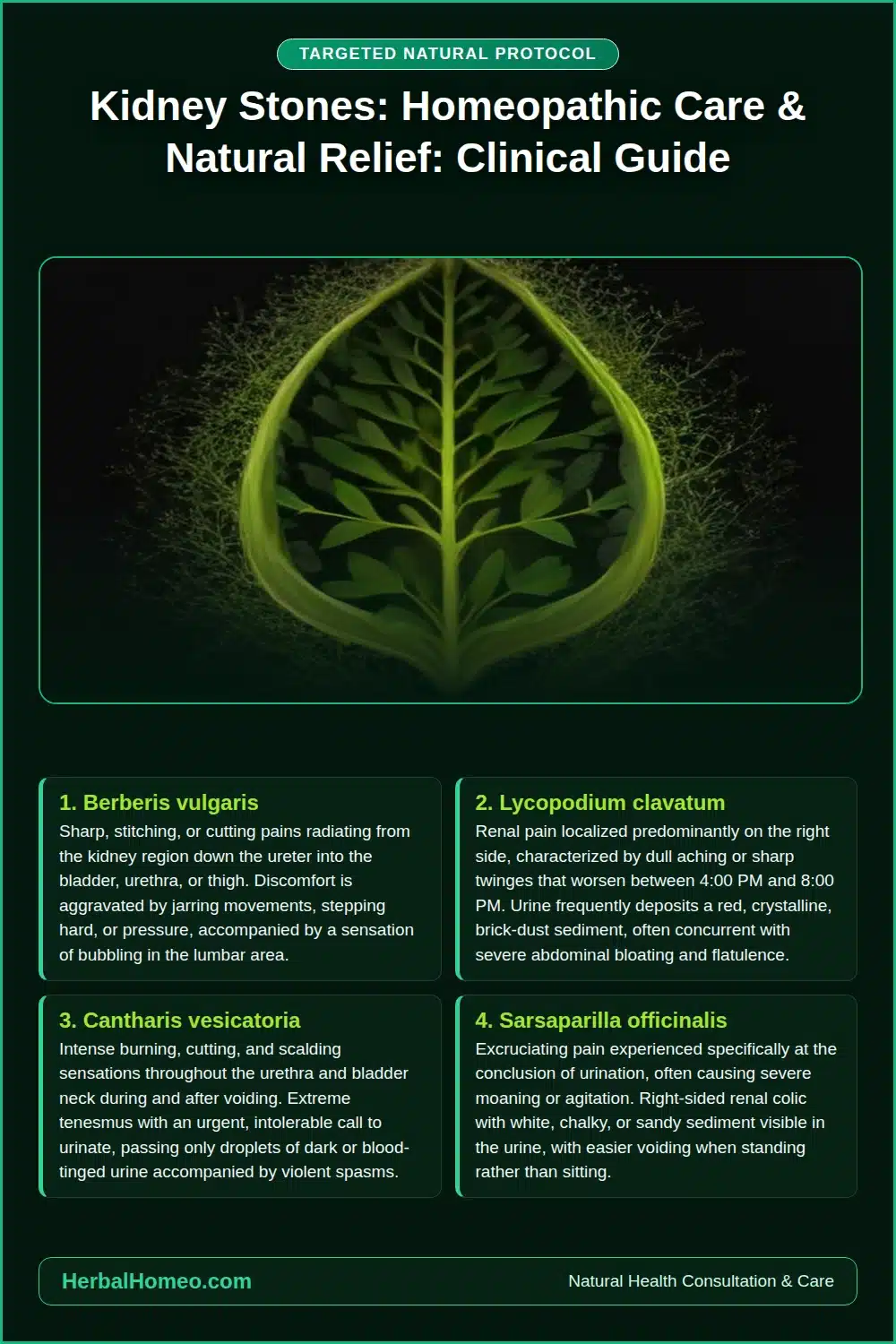
Berberis vulgaris is one of the most prominent remedies in renal pathology, particularly when symptoms show a marked affinity for the left kidney. The classic indication is sharp, stitching, or cutting pain that radiates outward from the renal area into the ureter, bladder, groin, testicles, or down the inner thigh. Patients frequently report an unusual sensation of bubbling or trembling in the lumbar area. The discomfort is intensely aggravated by movement, jar, prolonged standing, or heavy footsteps, leading the individual to sit completely immobilized. The urine is often turbid, thick, and displays yellowish-red or clay-colored sediment.
2. Lycopodium🌿 LycopodiumMateria Medica Clinical Profile: Click to explore Boericke keynotes, symptoms, modalities, and dosage guidelines. clavatum: Right-Sided Uric Acid Diathesis
Lycopodium clavatum is predominantly indicated in right-sided renal colic and in patients prone to chronic uric acid diathesis. The pains typically manifest as a deep, aching distress or acute cutting twinges along the right flank and ureter, with a distinct diurnal aggravationWorsening of symptomsAn increase in severity or intensity of symptoms, often caused by environmental factors or after taking a remedy. occurring between 4:00 PM and 8:00 PM. A hallmark clinical keynote is the presence of red, sandy, brick-dust sediment deposited in the chamber pot or clinging to the diaper/underwear. Individuals who require this remedy often suffer concurrently from digestive insufficiency, excessive flatulenceGas accumulation in stomach or intestinesThe presence of excessive air or gas in the digestive tract, causing bloating and wind., severe abdominal distension, and a craving for warm beverages.
3. Cantharis🌿 CantharisMateria Medica Clinical Profile: Click to explore Boericke keynotes, symptoms, modalities, and dosage guidelines. vesicatoria: Severe Burning and Spasmodic Tenesmus
When the passage of a calculus provokes intense inflammation and ureteral or vesical spasm, Cantharis is frequently indicated. The symptom picture is dominated by unbearable, violent scalding sensations before, during, and especially after urination. There is a constant, agonizing urge to pass urine, yet the patient can void only a few drops at a time, often accompanied by blood or shreds of mucous epithelium. The patient exhibits extreme mental restlessness, groaning from the sheer intensity of the urethral and vesical cutting pains, which feel as though the urinary tract is being seared with hot iron.🌿 Iron.Materia Medica Clinical Profile: Click to explore Boericke keynotes, symptoms, modalities, and dosage guidelines.
4. Sarsaparilla🌿 SarsaparillaMateria Medica Clinical Profile: Click to explore Boericke keynotes, symptoms, modalities, and dosage guidelines. officinalis: Terminal Dysuria and Sandy Debris
Sarsaparilla officinalis possesses a distinct affinity for urinary tract conditions involving fine gravel🌿 GravelMateria Medica Clinical Profile: Click to explore Boericke keynotes, symptoms, modalities, and dosage guidelines. and calculi. Its foremost clinical keynote is agonizing, excruciating pain experienced at the very close of urination, when the bladder contracts around the calculus or inflamed mucosal walls. The pain often causes involuntary cries or trembling. Renal distress is frequently right-sided, radiating downward into the genitals. Patients often observe that they can only pass urine freely while standing erect; attempting to urinate in a seated posture provokes renewed spasm and retention. The urine may contain white🌿 WhiteMateria Medica Clinical Profile: Click to explore Boericke keynotes, symptoms, modalities, and dosage guidelines., chalky flakes or gritty sand.
5. Ocimum🌿 OcimumMateria Medica Clinical Profile: Click to explore Boericke keynotes, symptoms, modalities, and dosage guidelines. canum: Colic Associated with Severe Emesis
Derived from the Brazilian Alfavaca plant, Ocimum canum is indicated in acute renal crises characterized by prominent autonomic involvement, especially severe, persistent nausea and violent vomiting during stone movement. The pain is located mostly in the right kidney and ureter, causing the patient to twist, cry out, or bend double in an effort to alleviate the intolerable tension. Urine produced during these episodes is typically cloudy, reddish, or saffron🌿 SaffronMateria Medica Clinical Profile: Click to explore Boericke keynotes, symptoms, modalities, and dosage guidelines.-colored, giving off a strong odor and precipitating thick, uric-acid-rich sediment upon standing.
Constitutional Care: Managing the Diathesis and Recurrence
While acute remedies address the immediate spasm of renal colic, constitutional homeopathic management seeks to balance the body’s internal chemistry to prevent stone recurrence. In classical homeopathy, recurrent stone formation is associated with the sycotic and psoric miasmatic terrains, frequently expressing as chronic metabolic imbalances, impaired hepatic clearance, and inefficient uric acid excretion.
A comprehensive constitutional evaluation analyzes the patient’s entire physical, emotional, and systemic profile. Remedies such as Calcarea Carbonica🌿 Calcarea CarbonicaMateria Medica Clinical Profile: Click to explore Boericke keynotes, symptoms, modalities, and dosage guidelines., Nux vomica🌿 Nux VomicaMateria Medica Clinical Profile: Click to explore Boericke keynotes, symptoms, modalities, and dosage guidelines., Phosphorus🌿 PhosphorusMateria Medica Clinical Profile: Click to explore Boericke keynotes, symptoms, modalities, and dosage guidelines., or Sulphur🌿 SulphurMateria Medica Clinical Profile: Click to explore Boericke keynotes, symptoms, modalities, and dosage guidelines. may be prescribed not because of the location of the stone, but because they match the underlying metabolic rhythm, digestive weakness, and neuroendocrine tendencies of the individual. By strengthening the vital force and optimizing organ function, constitutional therapy aids the kidneys in maintaining proper electrolyte solubility, helping diminish the frequency of future crystalline aggregations.
Integrative Dietary and Lifestyle Strategies
Homeopathic care should be paired with scientifically grounded nutritional and lifestyle habits to create an environment hostile to crystal precipitation. Clinical outcomes are substantially improved when patients commit to strategic self-care measures:
- Targeted Fluid Intake: The single most reliable measure in lithiasis prevention is keeping urinary volume above 2.0 to 2.5 liters daily. Sipping filtered water🌿 WaterMateria Medica Clinical Profile: Click to explore Boericke keynotes, symptoms, modalities, and dosage guidelines. consistently throughout the day and before sleep reduces mineral concentration and minimizes nocturnal stagnation.
- Citrate Optimization: Citrate acts as a natural crystallization inhibitor. Adding fresh lemon🌿 LemonMateria Medica Clinical Profile: Click to explore Boericke keynotes, symptoms, modalities, and dosage guidelines. or lime juice to daily drinking water helps raise urinary pH and enhances citrate levels, which naturally binds to calcium and discourages oxalate crystallization.
- Nutritional Modulation: Tailor dietary choices to the specific stone composition. For calcium oxalate formers, moderating very high-oxalate foods (such as spinach, beets, rhubarb🌿 RhubarbMateria Medica Clinical Profile: Click to explore Boericke keynotes, symptoms, modalities, and dosage guidelines., and black🌿 BlackMateria Medica Clinical Profile: Click to explore Boericke keynotes, symptoms, modalities, and dosage guidelines. tea🌿 TeaMateria Medica Clinical Profile: Click to explore Boericke keynotes, symptoms, modalities, and dosage guidelines.) while maintaining adequate dietary calcium during meals binds oxalates in the gut rather than the kidneys. For uric acid stones, reducing purine-heavy foods like organ meats, shellfish, and alcohol assists in stabilizing systemic acidity.
- Sodium and Animal Protein Moderation: High sodium consumption drives calcium excretion into the renal tubules, encouraging stone development. Replacing excess sodium and heavy meat consumption with plant-rich, anti-inflammatory whole foods protects renal filtration dynamics.
Clinical Boundaries and Emergency Red Flags
While homeopathic medicine offers supportive benefits during uncomplicated renal colic and helps prevent recurrence, clear safety guidelines must always be honored. Acute urinary obstruction can rapidly compromise renal parenchymal integrity and precipitate life-threatening urosepsis.
Patients must seek immediate emergency medical care if any of the following clinical warning signs occur:
- Fever, rigors, or chills concurrent with flank pain, which indicate potential pyelonephritis🩺 PyelonephritisClinical Disease Treatment Profile: Read homeopathic remedies, dietary recommendations, and natural therapeutic options. or an infected obstructed kidney.
- Complete inability to pass urine (anuriaFailure of kidneys to produce urineA severe condition where the kidneys stop producing urine or produce less than 100 ml per day.), representing bilateral obstruction or an obstruction in a solitary kidney.
- Intractable vomiting preventing essential oral hydration and medication retention.
- Uncontrolled pain that fails to respond to initial supportive interventions.
- Gross, visible hematuriaPresence of blood in the urineA condition where red blood cells are present in the urine, making it look pink, red, or smoky. with passage of large obstructive blood clots.
Imaging modalitiesFactors that make symptoms better or worseEnvironmental influences (like temperature, weather, rest, motion, or time of day) that modify symptoms. such as non-contrast computed tomography (CT) or renal ultrasonography remain invaluable to determine calculus dimensions and position. Calculi exceeding 6 to 7 millimeters in diameter are substantially less likely to pass spontaneously and often require conventional surgical or urological intervention to prevent long-term parenchymal damage.
Professional Guidance for Long-Term Urinary Health
Navigating renal colic and chronic lithiasis requires a balanced, integrative approach that honors both modern diagnostic precision and individualized natural therapeutics. Working with a qualified homeopathic practitioner allows for systematic constitutional analysis, selecting remedies tailored specifically to your metabolic predispositions, lifestyle factors, and unique symptom profile.
This article is for education and does not replace diagnosis or treatment by your doctor. Do not stop prescribed medication without medical advice.
If you are experiencing recurrent urinary tract discomfort, seek an individualized homeopathic evaluation designed to address your systemic wellness from the inside out. Book an online consultation with an experienced homeopathic practitioner to receive personalized support on your journey toward lasting vitality.
This article is for educational purposes only and not a substitute for professional medical advice, diagnosis, or treatment. Always seek the advice of your physician or other qualified health provider with any questions you may have regarding a medical condition.

Dr. Luqman Naseer
This article is for informational purposes and has been reviewed for medical accuracy according to classical homeopathic principles. Editorial Policy.